Thursday, February 06, 2014

Character education in public schools

A reader posted a comment, link, suggesting that I inform myself about what it is I'm trying to defend.  Actually, based upon my background and experience I consider myself pretty well informed on this issue.  Nevertheless, I followed their link to the Wikipedia, link, just to make sure.

There are some problems, they aren't new.  One issue is over what to teach; what is ethical, what is moral?

There is no consensus on which terms to use, or even how many pillars or principles to address and that is problematic.

According to the Wikipedia, salvation comes from Aristotle;

The key to finding this balance is to enjoy and recognize the value of developing one’s rational powers, and then using this recognition to determine which actions are appropriate in which circumstances.
Developing rational powers and using them to determine what is ethical or moral under the circumstances, requires a certain amount of learning and thinking about ethics and morals.

At the very least, character education requires a common vocabulary and mutually understood tenets.  It requires teaching, learning and practicing.  None of which will happen if we give up entirely on efforts to provide character education in public schools.

    • The formation of character in young people is educationally a different task from and a prior task to, the discussion of the great, difficult ethical controversies of the day. - William J. Bennett, author and former U.S. Secretary of Education (b. 1943)

    • If we want our children to possess the traits of character we most admire, we need to teach them what those traits are and why they deserve both admiration and allegiance. Children must learn to identify the forms and content of those traits.- William J. Bennett

    • To educate a person in mind and not in morals is to educate a menace to society. - Theodore Roosevelt, American adventurer and president (1858-1919)

      Grad rate increase > 40% over three years - too good to be true?

      APS Executive Director of Communications Monica Armenta reports, link;

      APS saw gains in the graduation rate in every demographic sub group, but the biggest gains came from those students with disabilities. The graduation rate for that group increased more than 40% in three years!

      The increase is from 44.9% in 2011 to more than 63% in 2013. That rate jumped 14 percentage points in just one year. This is remarkable. Really.
      Really?

      40% growth in graduation rates over three years is indeed remarkable.  The growth can flow from either or both of two springs; lower standards or increased performance.

      If standards were lowered to increase graduation rates, student interests were not served.  The Community was not served.  Only the interests of those who need higher gradation rates to keep their jobs, were served.

      It's not the graduation certificate that gets you through the rest of your life, it's the knowledge and skill set that the graduation certificate is supposed to represent.  Making the certificate meaningless in order to give more of them out is utterly indefensible.

      On the other hand, if knowledge and skill set have actually grown more than 40%, it represents a near doubling of successful efforts to educate.  Again, "remarkable";
      worthy of being or likely to be noticed especially as being uncommon or extraordinary
      Worthy of coverage in journals of education.

      Worthy of coverage in the Albuquerque Journal.

      If a number of APS teachers, staff and students are experiencing unheard of success, it is newsworthy. Where is the investigation and report?

      Journal Editor Kent Walz
      It's time for the Journal to step up to their obligation to inform the democracy about the public interests in the public schools.

      Enough is enough.


      photo Mark Bralley
      Walz; ched macquigg 

      Tuesday, February 04, 2014

      APS Board reining in Kathy Korte?

      If nothing else, APS School Board Vice President Kathy Korte is volatile and vociferous.

      Korte seconds after attacking photo journalist Mark Bralley

      Korte, feeling stalked and intimidated by Mark Bralley
      Korte's v and v are creating problems for the Board.  Korte is known to show up in places and advocate on behalf of issues, not all of which necessarily enjoy the mutual support of the rest of the board.

      When Korte speaks outside board meetings and speaks as "APS School Board Vice President Kathy Korte", a perception is created that Korte speaks for the board.

      No problem if they and Korte are in tune.  It becomes a problem if and when she wanders off the reservation. APS School Board Policy makes it very clear; school board members have zero authority except when acting as a board.

      Exceptions are made.

      The most notable of which is the fact that APS police officers, the board's Praetorian Guard, freely admit that they take orders from board members despite their lack of authority to give them. 

      They freely admit they will eject someone from a public meeting; someone who has broken no law, no rule, no regulation, and at the absolute whim of a board member, link.

      According their agenda, link, the APS School Board will discuss "Clarification of Board Member Advocacy".  The agenda indicates no action to be taken.

      APS board meeting agendas typically lack "reasonable specificity", a phrase that comes up in the New Mexico Open Meetings Act.

      Their agendas lack specificity because if more people knew what they were doing, more people would show up to watch them do it.

      How would you know from
      C. Clarification of Board Member Advocacy (Discussion)
      Presenter: Albuquerque Public Schools Board of Education
      whether you needed to be there or not?

      Board meeting attendance is routinely, abysmally low.

      The leadership of the APS like it that way.

      Attendance is low because nobody cares, because nobody knows what's really going on.

      Nobody knows what's going on because the establishment's press has let down the people.  They have failed to fully inform the democracy.

      The Journal aids and abets in their steadfast refusal to investigate anything in APS.

      Sure, they cover a scandal every once in awhile, link, when they haven't a choice.  Mostly they publish what the PR wing of the APS would like them to.

      Where is the Journal coverage of the cover up of that scandal?

      Doesn't the democracy need to know about the cover up even more than they needed to know about the scandal?  Isn't the cover up more newsworthy now, than the scandal was then?

      Why hasn't Managing Editor Kent Walz told readers that nobody ever investigated felony criminal misconduct involving APS senior administrators except APS' own investigators or investigators in their employ?

      Why hasn't Walz told readers that evidence of felony criminal misconduct was never turned over to the DA for prosecution?

      Why hasn't Walz told interest holders that even after statutes of limitation on felony criminal misconduct have expired, all of the findings of all of the investigations are still being hidden from public knowledge by the leadership of the APS and their lawyers, in blatant violation of the New Mexico Inspection of Public Records Act?

      Why hasn't the Journal investigated and reported upon the cover up, except that they are part of the cover up?

      Why are KRQE, KOAT, and KOB TV's so call community serving investigative teams not picking at this scab?

      Except that they are at the management level;, at the former APS School Board heavy hitter Paula Maes' NM Broadcasters Association Affiliate level, are part of the cover up.


      photos Mark Bralley and Korte's own facebook.

      Sunday, February 02, 2014

      Do graduation rates and SAT scores correlate? Should they?

      The leadership of the APS would have interest holders believe that graduation rates in the APS are improving and further, that the improvement is the product of their leadership.

      At about the time students complete high school, in particular if they intend attend college, they take the SAT, ACT or both.  They are nationally normed cumulative tests.  The most recent data I found on APS' award winning website, link, shows little growth over roughly the same period they claim significant growth in graduation rates.

      It seems discordant that measures of learning and proficiency like the SAT and ACT do not correlate more directly with graduation rates.  Are the tests not fair measures of the success a school district is having.  There are some problems with looking a longitudinal test results on standardized tests because the results are re-normed too frequently to compare long term, but they are still meaningful measure of short term growth or decline.

      This discordance is relevant because growth in standardized test scores and graduation rates are both considered to be indicators of success.  APS claims considerable growth in graduation rates (as much growth as from 50 to 73% graduation rate in last several years) at the same time SAT and ACT scores remained considerably more static.  The ACT average for APS was in the very low 20s out of 36 possible.  The average SAT score for APS appears to be mid 1500's out of 1800 possible.

      The disparity stems from an ability to manipulate graduation rates more easily than SAT and ACT scores.  A good part of the increase in APS graduation rates flowed from changes in the way the graduation rate was calculated, not necessarily because APS was doing a better job of educating students.  The changes; going from a four year plan to a five year plan, and dropping students who fail the 9th grade out of their cohort, raised graduation rates independently of educational growth.

      Why are the most current results two years old?

      Why aren't there more current data to consider?

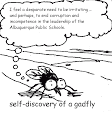
      In my experience with the APS, the truth is hard to find if it can be used to substantiate allegations of incompetence or corruption in the leadership of the APS.

      The ban on truth seeking is enforced by a publicly funded private police force accountable only to the leadership of the APS. 

      APS doesn't talk about the SAT and ACT because they are static and cast real doubt on their claims of dynamic growth in performance.


      photo Mark Bralley

      Brooks will hold public meeting on discipline

      The meeting is critically important because student discipline in the APS is in decline and has been for some time.

      Were the situation not in decline, we would have heard as much from APS Executive Director of Communication Monica Armenta.

      There would be hoopla and press conferences to tout the improvement.

      There would be a page in her calendar dedicated to better behaving students.

      Were the situation good, there would be corroborating records and empirical data supporting the claim.

      Were the situation good, the Journal editors would be singing high praise for their good friends in the leadership of the APS and their success.

      No news means bad news.

      Coincidental with the decline in student discipline is the utter abandonment of character education in the APS.

      The decline is fact;
      the abandonment is fact;
      only the correlation remains unexplored.

      APS Supt Winston Brooks will hold a public meeting at which he will offer a data rich presentation on student discipline in the APS.

      He will cover the history of problems in APS. 

      He will explain current efforts to maintain adult authority in classrooms and schools. 

      He will present APS' plans for the future, for addressing the issues of student misconduct and chronically disruptive students.

      He will take questions from interest holders.

      Unfortunately the media will not be able to cover the meeting.

      They will be otherwise occupied, reporting on a number of more remarkable events that will happen earlier in the day;

      • pigs will fly,
      • fish will speak,
      • rocks won't sink,
      • snakes will smoke,
      • frogs will grow hair,
      • hell will freeze over,
      • chickens will grow teeth,
      • fish will climb poplar trees,
      • grapes will grow on willows,
      • the sun will rise in the west,
      • white crows will fly upside down,
      • crayfish will whistle on the mountain,
      • and, monkeys will fly out of my ass.
      Adynatons; wikilink


      photos Mark Bralley

      Does education in the APS include character education? Should it?

      Whether you agree that character education, a deliberate and concerted effort to enable children to grow into adults who embrace character and courage and honor, is or should be part of public education is an important question.

      It is far too important a question to remain unasked.

      In 1994, the APS Board of Education passed a resolution adopting character education in the APS.  The resolution has never been rescinded; it is as binding today as it was the night they passed it unanimously.

      Please read the resolution.  Read it carefully.  Point to anything that is not as true today as it was in 1994.

      Resolution

      To endorse and Implement Character Counts! Program in the Albuquerque Public Schools

      Whereas, Albuquerque Public Schools reaffirms the need to join with other community groups to actively engage in the development and demonstration of ethical behavior among youth, adults, and

      Whereas, the mission of Albuquerque Public Schools is to provide learners of all ages the skills and knowledge needed to become successful and productive members of a dynamic society, and

      Whereas, the Albuquerque Public Schools recognizes that students in our schools are more likely now than in the past to experience family disintegration, homicide, drug use, teen age pregnancy, dishonesty, suicide, and strong messages from media and society that undermine home teaching of ethical values, and

      Whereas, the Albuquerque Public Schools recognizes that no single community institution can instill ethical behavior in youth and adults if it is acting without the support of other institutions and groups, and

      Whereas, the Albuquerque Public Schools recognizes the important role played by teachers and other adults in school settings in modeling good character for young people

      NOW, THEREFORE, BE IT RESOLVED;

      1. That the Albuquerque Public Schools endorses the Aspen Declaration on Character Education, link, as well as the Character Counts! Program as ways to develop character based on six core ethical values; trustworthiness, respect, responsibility , fairness, caring and citizenship;

      2. That the Albuquerque Public Schools will enter into community-wide discussions with other institutions and groups to reach agreements about the role of each in promoting ethical behavior among young people, and adults in various aspects of life;

      3. That the Albuquerque Public Schools is committed to creating models of ethical behavior among all adults who serve students and schools;

      4. That the core curriculum should continue to give explicit attention to character development as an ongoing art of school instruction; (emphasis added)


      5. That materials, teaching methods, partnerships, and services to support school programs shall be selected, in part, for their capacity to support the development of character among youth and adults;

      6. That all schools examine school curriculum and practices to identify and extend opportunities for developing character, especially through the utilization of violence-prevention programs, mediation training, community service programs. fair rules which are fairy enforced, democratic practices in classrooms and organizations, and extracurricular activities which help students learn and model caring and ethical behavior.

      DATED this 2nd day of March, 1994
      Should the leadership of the APS be allowed to simply turn their backs on this resolution?  Should the senior-most role models in the entire APS be allowed to simply abdicate without saying a word?

      Before role models can expect students to hold themselves accountable to higher standards of conduct than their own, shouldn't they have to explain to them, in words any child can understand,
      why students are expected to model (honest accountability to) and promote the Pillars of Character Counts!, link, and school board members and the superintendent are not.
      The school board and senior administration employ a publicly funded private police force, a Praetorian Guard if ever there were, to use their uniforms and badges and guns to prevent me from standing at the podium during public forum and insisting that they defend their abandonment of their obligation to model and promote honest accountability to higher standards of conduct than the law.

      They wouldn't be able to get away with this without the aid and abet of Kent Walz' Journal in a coverup of an ethics and accountability scandal in the leadership of the APS.

      The Journal and Paula Maes' NM Broadcasters Association affiliates; KRQE, KOAT, and KOB are willfully ignoring credible evidence of a standards and accountability crisis of high order.

      Perhaps if you and enough others ask them to, the editors and news directors in the establishment media, will investigate and report upon APS administrative and executive standards and accountability; whether the standards and accountability in APS are adequate to protect the public interests in the public schools.

      The press has a responsibility to inform the democracy,  They have an obligation to provide a candid, forthright and honest accounting of the standards and accountability in government.

      Are the standards high enough?  Is the accountability swift and certain enough?
      Are APS school board members and senior administrators honestly accountable to meaningful standards of conduct and competence?
      They are not and somebody needs to do something.

      When people say "somebody should do something", mostly they mean somebody else needs do something.

      And nothing gets done.


      You have an opportunity to defend character education in the APS. Insist that the Journal link, KRQE link, KOAT link, and KOB link investigate and report upon the state of character education in the APS. Insist upon being told the truth, the whole truth and nothing but the truth.

      Or you could hope that enough other people do.

      I'm not saying these people are evil, but when Edmund Burke wrote;
      the only thing necessary for evil to prevail in the world
      is for good men to do nothing
      this is the evil he was writing about. You are who he was writing to.

      Sacrifice is the currency of commitment.  If one is not willing to make a sacrifice in defense of a principle, the must wonder what is their commitment to the principle in the first place.  What is our commitment to the ethical development of students in the APS?

      What sacrifices are the leadership of the APS willing to make to grow students in to adults who embrace character and courage and honor.  Are they willing to show them what it looks like?  They are not and it is up to you to hold them accountable.

      One of your trusted news outlets will be the first to tell you the truth about the ethics and accountability scandal in the leadership of the APS, all the rest of them will be among the last.

      Saturday, February 01, 2014

      High school graduation rates; incremental growth is unsustainable.


      The public schools are engaged in an endeavor at which are about 70% successful.  Seven out of 10 children who enroll in a public high school leave with a diploma.

      Never mind that the many of them can't read.

      Never mind that most of them will require remedial education before they can begin college.

      Never mind that most of them haven't a skill set that will help them find a good job.

      Improvement in any endeavor can be incremental or cataclysmic.

      The growth we are seeing in public school education is incremental.  Basically, we picking a few leftover low hanging fruit. There is only so much low hanging fruit.  There are not enough low hanging fruit to continue to get better by two percent every for the next twelve years.  There are children in kindergarten today, who will drop out of school before incremental reform would be complete even if it were possible.  It isn't possible.

      There is no magic.  Nothing can remedy the fundamentally flawed group learn model for public school education.  It cannot be redeemed.

      The only hope for public education and 30% of students is cataclysmic change.

      A cataclysmic change by definition could raise graduation rates overnight.

      Perish the thought, but if all the schools burned down and all the teachers disappeared, how long do you think it would take for people to figure out that they can learn pretty much everything they
      will ever need to know, sitting at a computer connected to the "internet"?

      The modern mission of public school education is to create independent lifelong learners.  The primary objective is to create independent lifelong learners at the earliest opportunity.

      When learning becomes independent, we can insist upon mastery level learning.  Students will master material and move to the next at their own speed and with the fundamentals they need to master it as well.

      When students learn how to learn independently, teachers will no longer be charged with making 30 individuals learn in unison.

      Trust me, it will free up a lot of their time.  It will give teachers real time to pay attention to individual students and their individual needs.

      Graduation rates will skyrocket, overnight.


      photo Mark Bralley

      Friday, January 31, 2014

      APS lawyers' ethical misconduct; you be the judge.

      For the purposes of this post, ethical means ethical as it is conceptualized APS student standards of conduct; the Pillars of Character Counts!; a nationally recognized, accepted and respected code of ethical conduct and decision making.  Because the Pillars are the standards of conduct for students, they are the standards of conduct for their senior-most role models; the senior administration and school board.

      The "leadership" of the APS cannot pretend to be accountable to high standards as role models and claim then different, lower standards as defendants in legal proceedings.  If they think it's OK, then they need to explain exactly why it is OK, and in words any child can understand.

      Bralley by Mary Ellen Broadrick
      APS is being sued by Mark Bralley.  Bralley is a photojournalist and blogger.

      He is suing APS over their several violations of his civil rights as a citizen and as a member of the press.

      The Journal is yet to cover the story.

      Journal Managing Editor Kent Walz and the Journal have yet to acknowledge the litigation.  Co-incidentally, that litigation is not going to go well for the leadership of the APS nor for students, teachers and taxpayers.

      The Journal, as a newspaper of record, has an obligation to inform the democracy when their power and resources are at stake.  The Journal knows the drill; they covered the filing of my complaints, link, albeit lacking candor, forthrightness and honesty.

      Bralley is litigating pro se.  The rules of court procedure recognize that pro se litigants have little or no experience suing powerful people and their lawyers.  The rules discourage lawyers from using the rules against the interests of justice.

      Nevertheless, they are.  APS lawyers are trying to use the rules to obfuscate Bralley's efforts to hold their clients accountable for their incompetence and corruption.  They claim summons were not properly served, and therefore Bralley's several complaints should be dismissed.  They claim the summons were served on the wrong person.

      The truth is, Bralley made a considerable effort to determine the identity of the person(s) who were authorized to accept service.  At every opportunity, APS lawyers Art Melendres, Luis Robles, and Pat Allen had an ethical, and it can be argued - a legal obligation, to answer his questions candidly, forthrightly and honestly.  They could have when asked, simply told him the name of the person(s) who could accept service. They did not.

      Melendres is APS' Chief Counsel.
      He and his firm, the Modrall, have been making a killing off APS and taxpayers for decades.

      They make so much money litigating on behalf of APS, that Melendres in sworn deposition, could not recollect within a hundred thousand dollars, how much.

      He finally settled on a figure somewhere north of a $1.25M annually.


      Defendant Marty Esquivel gets his own lawyer Luis Robles, link.

      When Robles was presented with Bralley's Complaint, the subject of its extraordinary length came up.  Robles expressed his glee, indicating its length simply meant that many "more billable hours".

      Billed at what rate, and under the oversight of whom exactly, still to be determined.

      Only Esquivel gets his own lawyer, the rest of the defendants share the counsel of one lawyer. one Pat Allen, link..

      It is unclear how much money has been spent, or even if they are working on signed contracts, link.

      The leadership of the APS, the school board and senior leadership teams are litigating, literally, to save their individual and collective ass.

      It is their combined intention that they will not be held accountable for their conduct and competence, to any standards higher than the law.

      Is it legal?  They will argue that it is.

      In the meantime, they tell students that their character is forfeit should they be unwilling to do more than the law requires and less than the law allows.

      They are spending hundreds of thousands of operational dollars to pay lawyers to create cost is no object defenses against legitimate complaints, and to except them from honest accountability to any higher standard of conduct than the law.  In fact, their record is one of a lack of accountability even to the law.

      The law is the lowest standard of conduct.  It is the standard that every higher standard, is higher than.  Higher standards means higher standards than the law.

      So who says the leadership of the APS is accountable to higher standards of conduct?

      The leadership of the APS donned that mantel when they decided to establish and enforce higher standards of conduct on students.

      Students are expected, according to school board policy as expressed in the APS Student Behavior Handbook, link, to hold themselves accountable to higher standards of conduct;
      students are expected to model and promote the Pillars of Character Counts! Trustworthiness, Respect, Responsibility, Fairness, Caring, and Citizenship.
      Unless you accept their manifest position that senior-leaders in the APS have no real obligations as role models of student standards of conduct; they are accountable to higher standards of conduct than the law.  They are required to behave and litigate ethically.

      Evidence will show that Bralley made an earnest effort to serve process and that, that effort was obfuscated unethically and as a judge will determine, illegally.  Link to Bralley's Complaint, Motions to dismiss, objections and affidavits.

      Did APS lawyers hamper Plaintiff Bralley by misdirection and by failure to respond, thereby avoiding service?

      Did they actively or passively obstruct service by resorting to willful perjury, subornation of perjury and conspiracy?

      These are important questions.  If the people are to hold school board members accountable at election, for the conduct and competence of the administration the board oversees, the people have a need; moreover they have a right to the truth about the conduct and competence of senior administrators; public servants whose salaries they pay.

      The establishment's media has turned their collective back on their obligation to fully inform the democracy.  Whether complicit or complacent in the cover up of a standards and accountability scandal in the leadership of the APS, they have betrayed the trust placed in them by this community.

      Are APS administrative and executive standards of conduct and competence adequate?  Is there honest accountability to meaningful standards of conduct and competence?

      Whether there are high enough standards and swift and certain accountability is newsworthy.
      • It is newsworthy if there are adequate standards and accountability to protect the public interests.
      • It is more newsworthy if there are not.
      Either way, it's newsworthy.


      photos Mark Bralley

      Thursday, January 30, 2014

      Journal sees smaller classes as the answer - misses the point

      If there were a way to precisely measure the outcome of educational interventions, one could calculate cost effectiveness of each.  One might find that lowering class size by some percentage will raise test scores by some correlating percentage and, then employ interventions or not based on their cost effectiveness.

      Lowering class size is very expensive and according to research, a largely ineffective intervention until class sizes are nearly halved.

      Textbooks are very expensive and manifestly ineffective.  They are particularly ineffective for students who can't read.  And by "can't read" it is important to understand that in this context, can't read means can't read well.  Mediocre readers, the overwhelming majority of students, are not well served by textbooks.

      Ask a teacher, ask if they would rather have a different primary learning resource.  Textbooks are most useful and most used as a teaching tool when a teacher's immediate need is to keep 30 squirming minds and bodies under control.  Textbooks are employed in unison, every student opens to the same page at the same moment.  Faster readers grow bored, slower readers fall still further behind.

      The Journal editors this morning, expressed opinion on the effectiveness of smaller classes.

      I would be willing to bet a modest sum, that their opinion is not expert.  I would bet not one of them has taken advantage of the opportunity to substitute teach for a day.  I would be willing to bet a similar sum that not one Journal reporter, nor any investigative reporter for any TV or radio station, has substitute taught for a day.

      There is no evidence to suggest that the establishment media has made any effort at all to find out what teachers think about what's going on in classrooms and schools.  There have been no surveys, no interviews, no investigations.  Do they really want smaller classes or might they want something else instead?

      Maybe they would rather have larger classes and more control.

      Doesn't it seem odd to anyone at all, that there has never been an investigation and report on discipline in schools?  I represent that it is a significant problem.  In some classrooms and schools, it is the number one problem.  And yet, the truth remains hidden.

      Why hide the truth about discipline in schools?

      It is because the responsibility for establishing and enforcing discipline policies does not rest on teachers.  It rests squarely on the shoulders of school board members and administrators and they have the power and influence necessary to hide the truth about their failure.

      To admit failure to establish and enforce meaningful standards of conduct is to admit to executive and administrative incompetence.  And to the extent that guilty knowledge is malfeasance, failure to remedy administrative incompetence is corrupt.  The executive and administrative failure to keep schools under control is manifest incompetence and corruption.

      And that is why we never talk about student discipline and the effects of chronically disruptive students in APS classrooms and hallways.

      It is fair to wonder how the establishment media remains disengaged.  It might be complicity - maybe the leadership of the APS asked them to help with the cover up and they obliged.

      Maybe it is complacency, maybe they just don't care.
      If so, they should worry it might be true that;

      The hottest places in hell are reserved for those
      who, in times of great moral crisis, are complacent.

      unk derived

      Tuesday, January 28, 2014

      Teachers, should they have authority over students?

      Should a teacher have a right and responsibility to tell a student to

      Stop doing that.
      and should the student be expected to comply?

      If a teacher, or any other adult at school tells a child to stop doing that and the child's response means no, something must be done.

      The permission of prohibited behavior is categorically unacceptable; in particular as a matter of practice.  It sends exactly the wrong message.  It undermines authority.

      What is the point of rules if no one has to obey them?

      It is not up to a classroom teacher to address the issues that lead a student to conclude that they are in charge.  It is particularly not alright for a teacher's attention to be drawn from students who need it for more productive ends.

      The establishment and enforcement of discipline polices is an executive (the school board) and administrative responsibility.  The inability or unwillingness to create and enforce standards of conduct that protect the interests of all stakeholders, is an executive and administrative failure.

      For which they could be held accountable by the media, but will not.

      Student discipline is newsworthy by any standard; either the truth makes the leadership of the APS look capable or it makes them look incompetent and corrupt.

      Either they're on top of  the ball and deserve recognition, or they are behind the ball and must be held honestly accountable.

      Either way, its news.


      photo Mark Bralley

      More able students - time to set them free?

      In every public school classroom there are more able, less able and ordinarily able students.

      For as long as more able students have been in public school classrooms, they have been held back in their education while less and ordinarily able students were taught and retaught the same material.

      For as long as less able students have been in public school classrooms, they have fallen further and further and further behind until they drop out.

      There is no reason why students cannot acquire education at their own individual speed.  There is no reason a student cannot be expected to master material, however long that takes, before moving to the next.

      Even if you could take 30 kids with nothing in common but their age and then form them into thought choirs who can learn in unison, why would you want to?

      What purpose would does serve?

      If the goal of public school education is to create independent lifelong learners, why is it not the immediate objective?

      Forget about class size

      Imagine that a teacher is given a choice.  There are two classrooms and s/he can choose which s/he would like to teach. 

      All else is equal except that

      • one class is of 30 students all of whom are reasonably well behaved, and 
      • the other class is of 28 students at least one of whom is chronically disruptive.

      Which class do you think the teacher would choose?

      Unless s/he is a glutton for punishment, s/he will opt to teach 30 kids, rather than choose to spend their dwindling energy and resources trying to keep fewer kids under control because of the influence of as few as one out of control student.

      Reducing class size is by far, the most expensive and least effective way to establish and maintain control in classrooms and schools.  Teachers, if they were asked, would rather have real control over their classrooms and schools, than fewer students.

      Yet the discourse is not about reestablishing control in schools, it is about lowering class size.

      The issue is one of control, pure and simple.  A classroom is either under the control of, or out of the control of the adults in the room.  One is an educationally efficient environment and the other is not.  It makes a difference.

      Who is really "in charge" in classrooms and schools, adults or students?

      I submit;
      If adults establish rules and students deliberately break them, then students are "in charge".

      Take for example; students in charge in APS schools.
      It is actually APS School Board Policy that students are prohibited from "sagging". Go to any APS school;
      • If there are students sagging, saggers are in charge at that school.  
      • If students are smoking in prohibited spaces, smokers are in charge at that school.  
      • If students at that school can tell you the names of bullies at that school, the bullies are in charge at that school.
      This isn't about "sagging", or smoking or bullying.  

      It is about students defiantly engaging in prohibited behavior. 
      It is about students being "in charge" in classrooms and schools and the consequent negative effects that creates.

      Those whose job it has been to establish and maintain the authority of adults in schools would rather talk about class size than their failure to get classrooms and schools under control.

      Arguing about reducing class size draws attention away from problems that could be solved if any real attention was paid to them.  Problems like restoring order in classrooms and schools.

      Why is student discipline never discussed?

      Where are the historical data, current statistics and future plans?  Where is the truth about student discipline in APS?

      There is only one reason to hide the truth, and that is
      to escape the consequences of so doing.

      The leadership of the APS cannot show you a record of establishing control in schools, or there would not now be, out of control schools.

      The leadership of the APS cannot show any empirical data that demonstrates that they are in currently in control in schools.  And most importantly, they cannot show you their plan for regaining and maintaining control in schools in the future.

      The establishment and enforcement of discipline policies is an administrative and executive responsibility.

      The out of control in schools and classrooms is manifest administrative and executive failure.

      That's why the leadership of the APS is hiding the truth about student discipline problems in the APS.

      Far more sinister; that the establishment's media is helping them hide the truth about the effects of out of control students on the education of all students.

      Why won't they investigate and report upon student discipline in the APS from teachers' perspective?  Why won't they publish the truth?

      Ask them.


      photo Mark Bralley


      Monday, January 27, 2014

      APS transparency; an illustrative example of abject insufficiency

      The leadership of the APS and their cronies in the establishment media would like stakeholders to believe that the administration of their trust and treasure by the leadership of the APS is transparent.  It is not.

      The most current example; the meeting tomorrow of the Audit Committee, link, and their discussion of Ethical Advocate statistics.

      Ethical Advocate is a whistle blower program.  It is the only venue where an employee or community member can file a complaint of administrative or executive incompetence or corruption, and be protected from retaliation over the complaint.  Supposedly; in practice the promised anonymity for the complainant is only temporary.

      The Ethical Advocate statistics, link, will be presented by APS Director of Internal Audits Peg Koshmider.

      The only information she and the leadership of the APS are prepared to produce is the number of complaints filed by month and year, and the number of complaints that have been "closed".

      A "closed" complaint is a complaint filed against an administrator that is then adjudicated by another administrator.  An appearance of a conflict of interests is created when administrators investigate each other.

      At one time, the school board addressed the conflict of interests by promising to review and approve the administrative self investigation of every single complaint.  When called on the commitment, they changed school board policy and abandoned their executive oversight over administrative self investigation.

      In any event, there is a missing statistic.  How many Ethical Advocate complaints against administrators are settled to the satisfaction of the complainant?  How many complainants think their complaint was denied due process?

      I have filed three complaints under Ethical Advocate and its predecessor Silent Whistle.

      I complained that APS Supt Winston Brooks had abandoned his responsibilities as the senior-most administrative role model of student standards of conduct.

      Later, I complained that, that complaint had been "closed" without due process.

      And finally, I complained that APS Chief Operations Officer Brad Winter had promised to produce a candid, forthright and honest accounting of spending at 6400 Uptown Blvd. and did not.

      All three of the complaints were "closed" though Brooks is still not accountable as a role model of student standards of conduct, and Winter has still has not told the truth about the millions and millions of dollars they have spent on their own offices.

      Not so transparent; millions spent in and on their castle keep.

      There is an ethics and accountability scandal in the leadership of the APS.  The lack of real transparency in the leadership of the APS in a manifestation of that scandal.

      The media is complicit in, or complacent over the cover up of that scandal.  Their ongoing failure to investigate and report upon administrative and executive standards and accountability is a manifestation of their complicity and or complacency.


      photos Mark Bralley

      Sunday, January 26, 2014

      Ed reforms shallow and in the end, feckless

      If the goal is to educate, one has two choices; focus on the individual needs of students or, focus instead upon the needs of (arbitrary) groups of students.  "Arbitrary" in so far as all educational achievement gaps are individual and grouping them in order to apply group solutions serves no ultimately useful purpose.

      In order to believe there is a "group achievement gap", the belief must rest on a foundation; that membership in the group affects individual performance.  In order to accept that there is an Hispanic educational gap, one must accept that being Hispanic by itself, affects educational achievement.  It is prejudice.

      All achievement gaps are individual.  The most direct and effective solutions will be those that address individual needs individually.

      There are those who will argue that we cannot afford enough teachers to give every student the individual attention they need.  Grouping is cheaper, they would argue, than individualizing.

      "Cheaper" at what cost?  Grouping students is an expedient, a management tool created to address a problem that didn't exist until the students were grouped for no educationally useful purpose.

      In addition to meeting the individual needs of students, teachers are compelled to manage the group dynamic.  Attention must be shared.  In some classrooms, teachers spend so much time and energy on controlling a group of largely recalcitrant children, there is no time to spend in individual attention to individual needs.  Keeping students in "formation" can consume far more time and energy than would addressing their individual needs.

      The model in use in public schools is to teach, learn and test in groups.

      30 kids with little more in common than the year of their birth, are formed into a thought choirs and expected to learn in unison for the next twelve years.

      That model is a manifest failure.  Half of high school graduates are not prepared for college.  Far too many can't even read.

      I am aware of no reform of the accepted model, proposed or enacted, that will raise performance more than a few percent; likely less than the margin of error in the measurement.  Even as bold (and inadvisable) step as holding back "non-readers" in the third grade is not going to greatly change the outcome meaningfully.

      The only reform that has the potential to really change the game, that could actually result in meaningful improvement, is the abandonment of group learning and the embrace of independent learning.  I suggest that the fundamental goal of public education be reformed, from the effort to standardize individual performance to an effort to recognize and enable individual performance.  The goal of public education should be the creation of independent learners; people who can learn without the need for public "schools".

      From a practical standpoint, it is impossible and therefore unrealistic to insist that an entire group of students demonstrate mastery level learning before the rest of the group can move on.  Inevitably faster learners will be held back and slower learners will acquire fewer and fewer basic skills.  And, no one will have had to demonstrate that they have truly mastered anything.

      Perhaps the greatest benefit of switching from group to independent learning is that we will finally be able to insist upon mastery level learning.  If learners are required to master basics at every level before moving on, there will be no third graders who can't read.

      An insistence upon mastery level learning is critically important and eminently useful.  Students who have mastered basics can acquire advanced skills more easily and effectively.  Students who have not mastered basic skills will not catch up; they will continue to fall further and further behind.

      Why does educational reform remain shallow and feckless?

      Why don't the people who insist upon cemetery seating and group learning, a dead horse if ever one died, ever have to defend their insistence?

      Why don't those who insist that the individual needs of students must continue to be subordinated in deference to the needs of arbitrary groups of students, never have to justify and defend their position?

      The short answer is; they
      never have to explain, defend
      or even acknowledge any of
      their positions on anything,
       
      ... because we can't make them.

      Might makes right.


      photo Mark Bralley

      Saturday, January 25, 2014

      Ideal pupil teacher ratio 1 to 1, and it is entirely doable.

      The Journal reports this morning, link, that NM Education Secretary Hanna Skandera will not prioritize reducing class size in allocating funding to public education.  She believes there are better places to spend money.  I'm inclined to agree.  From a teachers perspective, reducing class size from 30 kids to 29 won't make all that much difference.

      Skandera's research on class size is undoubtedly more recent and comprehensive than my own, but when I was still teaching, the research indicated that you had to get down to 15 to 1 before performance improved significantly.

      In truth, the optimum ration of teacher to student is one to one.  I heard someone argue once, that if you reflect on all the important things you have learned in your life, the overwhelming majority of them were learned in one on one conversations.

      Cemetery seating; gathering 30 kids who have nothing in common but the year of their birth and a zip code, and then insisting that they form a thought choir and perform as a group through their entire education, is an obsolete model of education.

      When there was only one teacher, or only one book, it might have been necessary to have every student focused on the same resource.  It no longer is.  The entire wealth of human knowledge is a key stroke away from anyone with internet access and the skill set they need to take advantage of it.

      There is no good reason to group educate students.  There is no justification for expending any more effort or resources trying to standardize individual performance.  By definition, group learning eliminates the opportunity to teach to mastery.  Mastery learning is the key to future learning.  A student with a C in math is going to have more trouble with math next year, than a student with an A in math.  Two students with the same command of math this year, will be equally successful next year.

      There is no such thing as a "group" achievement gap.  All achievement gaps are individual; one student, the skills s/he has already acquired compared to the skills s/he needs to acquire.  You can if you want, take all Hispanic students and average all their individual achievement gaps.  It is a meaningless statistic.  Unless you you believe students are inherently disabled by their heritage, there is no group solution that applies to them because of their heritage.  Group achievement gap statistics are useful only to those peddling group solutions to individual problems - publishers of textbooks and standardized tests.

      Take any student, ask them a relatively few questions, and a plan can be created that will enable that student to leave school with the skill sets they need to live happily ever after.  All we have to do is give every student the individual attention they need.

      Individual attention cannot be given to students in groups.  Teaching really can be likened to herding cats,especially young students.  The point being; you cannot spend a lot of time on any one kitten without the rest wandering off.  A teacher can spend some time with individual students if the rest of the can continue their education without the teacher's immediate attention.

      Mother cats don't make their kittens march in formation.  They allow inherent curiosity and enthusiasm to drive the quest for knowledge.  They create independent lifelong learners as quickly as they can.

      Cemetery seating suits the needs of a handful of average students.  More able students are held back, less able students are left behind.  They will not catch up.  They will continue to fall further and further behind until they drop out.

      Education reform in Roundhouse seems to be limited to beating a dead horse; group solutions for individual problems.  The model cannot be made to work.  If ever it was the best or only solution, it is no longer.

      Reform needs to include a reassessment of the most basic assumptions about education.


      photo Mark Bralley


      Friday, January 24, 2014

      APS Audit problems persist

      The Albuquerque Public Schools has been in business for more than a hundred years; since 1891.

      They have had more than a hundred years to figure out spend public resources according to the rules.  A recent audit finds they have not.

      KRQE was the first to report on the findings of the latest audit of the APS.

      They began by excusing APS for losing more than a million dollars worth of public property (most of it stolen by APS employees according to the APS Police force and School Board Vice President Kathy Korte, link.)

      According to KRQE, it really isn't the fault of APS leadership;

      Albuquerque Public Schools has more than 140 schools, thousands of employees and $1 billion budget. Things are bound to go wrong -- and stuff is bound to go missing.
      Did UNM loose a million dollars worth of computers last year?
      Did Sandia Labs?  Did the City of Albuquerque?

      On a more objective note, KRQE conceded;
      The findings included a lack of enforcement for financial policies and problems with record-keeping.
      KRQE argues on APS' behalf;
      Still, $1.2 million (in missing capital assets) is an improvement over the $1.9 million in missing assets reported the year before.

      KRQE then allowed their lawyer, School Board President Marty Esquivel to provide a statement.
      "Overall we feel it was a very positive audit because the number and nature of adverse findings has continued to decrease over the years.
      KRQE capped their defense of the leadership of the APS by pointing out for them;
      The number of state audit findings has gone down over the years, from 378 in 2009 to 93 in 2013.
      It begs a fair question; how long should it take to get it right?  Is a century really not long enough?  the two men most responsible for the audit findings take down nearly a half million dollars a year in salaries.  Are we not spending enough?

      Recent audits of the leadership of the APS have found;
      • administrative evaluations were subjective and unrelated to promotion or step-placement,
      • a lack of standards,
      • a lack of accountability to such standards as there are,
      • a lack of sound record keeping, 
      • data is being falsified (crime statistics)
      • audit findings are routinely ignored , and there is
      • a culture of fear of retaliation against whistleblowers.
      Those are the conditions which lead to audit findings.

      If you go looking on APS' award winning website, for audit findings (or the findings of any investigation of incompetence and corruption in the leadership of the APS) you will not find one; not one.  Despite all their assurances of transparency, despite their promise to post findings on their website, they are yet to post even one, link.

      The findings are being hidden from public knowledge.  They are being hidden in an ongoing effort to cover up administrative and executive incompetence and corruption.

      You can inspect those public records if you would like, but you will have to sue for them.  The litigation will be expensive and time consuming, and the leadership of the APS have all the time and all the money they could possibly ask for.

      The leadership of the APS is being sued in federal court over their refusal to produce the findings of investigations of felony criminal misconduct involving APS senior administrators and leadership of APS' police force, link.  Taxpayers are going to pay through the nose for APS' cost is no object legal defense and up to a hundred dollars a day for every day since they refused to produce them.

      I waited to write this post because I wanted to include any audit findings coverage from KOAT, KOB or the Journal.  Neither KOAT nor KOB has covered the story.  The Journal did.

      Managing Editor Kent Walz and the Journal, link, were quick to follow Esquivel's effort to draw eyes off the ball.  Instead of pointing to ongoing mismanagement, they point instead to "improvement"  in APS' efforts to manage its equipment.

      Never mind how badly they're doing, they're getting better.

      Never mind that after more than a century of efforts to establish honest accountability to meaningful standards of conduct and competence, they still have not.  Focus instead on the fact that they're "getting better".

      There are manifest standards and accountability issues in the leadership of the APS.  There is a need for a standards and accountability audit of the entire leadership of the APS; an independent impartial audit whose findings, all of them, will be made public.

      There is an ethics and accountability scandal in the leadership of the APS.

      The Journal and the local NM Broadcasters Assoc affiliates; KRQE, KOAT and KOB relentlessly refuse to investigate and report upon ethics, standards, and accountability issues in the leadership of the APS.  Not even to report that there are none.

      It's a cover up; pure and simple.


      photos Mark Bralley]
      Walz photo ched macquigg

      Wednesday, January 22, 2014

      Learn to read; read to learn.

      As is the nature of complex arguments in political discourse, the problem of students who can't read has been reduced to a saw, a sound bite; learning to read, reading to learn.

      Students must learn to read by the third grade in order to read to learn forevermore.

      It has a rhyme and rhythm that make it resonate, but the premise is fundamentally and flat out wrong.  Students do not have to be able to read in order to learn.  That non-readers can learn to read is proof.

      While reading is a useful skill in learning, and itself an important educational goal, it is not the only way to to learn. For non-readers and less than proficient readers, a textbook is in fact, among the most worst of resources.  The worse the reader, the more useless is a textbook.

      Students who want to learn everything else and how to read, should not be held back in everything else until they learn to read well enough to read to learn.  Rather, their interest and enthusiasm in any subject should be recognized, reinforced and exploited by use of any one of a number of other ways to teach and learn.

      The modern goal of education is to create independent lifelong learners.  This includes teaching students how to learn by every means available, not just by reading textbooks.  If the immediate objective is to teach reading, is there a worse book to hand to a child than a textbook?

      Gov Martinez, Ed Sec Skandera
      The textbook and standardized test publishers are a powerful lobby as there are a great many dollars being spent on textbooks and testing.

      In her State of the State, Governor Susana Martinez announced her intention that spending on textbooks will increase by 43%; some 9 million dollars.

      Am I the only one wondering about the sense in buying books for children who can't read?  How about some videotapes for children who can't see,  or some audiotapes for children who can't hear?

      Clearly, learning to read is important.  It is so important that we should be doing everything we can to help students learn how to read well at the earliest opportunity.

      But why does all growth have to swing on one hinge?
      Why can't growth in every area beside reading continue unabated while the student learns to read?  In particular in elementary school, why can't a student earn an A in math even though they're "flunking" reading?

      The problem is the reliance on textbooks as learning tools.  This though they are rarely, if ever, the best tool available.  They can be depended upon for neither currency nor accuracy, and still, they are nearly the only resource available to students and teachers.

      Learning, in the context of public education, is about performance on end of course testing.  If a student can pass the end of the course exam, what difference does it make how they prepared themselves for it?


      photos Mark Bralley

      Monday, January 20, 2014

      Rob Perry's conduct is reprehensible

      Rob Perry is Mayor Richard Berry's Chief Administrative Officer and he is a boor.  There is videotape proof beyond doubt, link.

      It has been nearly two weeks since his boorish outburst and it appears that he has gotten away with it.

      KRQE covered part of the story, link and promptly abandoned it. Though KRQE was aware of and asked for security footage of following incident in a parking garage, they are yet to cover it, link.

      I searched for and found no evidence that KOAT, link, KOB, link, or the Journal, link, covered the story at all.

      The establishment press walks on eggshells around powerful people.  They are caught twixt a rock and a hard place; an obligation to expose incompetence and corruption and a need to stay close enough to be able to find it.  Unless their investigation is likely to topple their target from power; they can't dig too deeply or they will loose access.

      The money quote from the KRQE piece is the usual from a good ol' boy who doesn't want either his conduct or character to be investigated; Perry said ... we'll move forward."

      Time to move along is good ol' boy speak for; there will be no more questions.  There will be no apology nor further acknowledgement.  There will be no letter of reprimand, there will be no consequences at all.

      The buck stops on Mayor Richard Berry's desk; he owns the tone in city hall.  People don't behave this way unless they are allowed.

      Is this really the kind of conduct citizens can expect from public servants in the Berry administration?

      Unfortunately, it is.


      When the press gets on Richard Berry's bad side, they find themselves on the outside looking in, link.


      photos Mark Bralley

      Friday, January 17, 2014

      APS' Office of Innovation cannot succeed. The rules don't allow it.

      APS has announced a new Office of Innovation, link.  It cannot succeed except marginally.

      Public education in general has a fundamental flaw; the relentless focus on the needs of arbitrary groups of students as opposed to individual needs of students.  There is no such thing as a group achievement gap except that someone has gone to the trouble of compiling one.  All achievement gaps are individual.  All achievement gap problems have individual solutions.

      Despite the many available alternatives, the relentless objective of public schooling is to take up to thirty kids with nothing in common but the year of their birth and a zip code, and then seat them in five rows of six desks, there to join into a thought choir; each student on the same page in same book on the same day.  That fundamental premise remains unchanged and makes real innovation impossible.

      The only innovation will be in innovative ways of  dealing with groups of students at once; standardizing individual performance; teaching and learning in unison.  Cemetery seating is obsolete, it cannot be re-tuned into usefulness.

      Imagine a stock car race.  The stock car superintendent announces that from now on, innovation will be not only allowed but encouraged.  You can do anything you want to make your car run better and faster.  No holds barred.

      But.

      Rule number one remains unchanged; at the end of every lap, your car and the others must cross the start/finish line in formation - five rows of six cars, no one allowed to move ahead, no one (supposedly) allowed to fall behind.

      For as long as students take standardized tests every year, they will take those tests seated in formation.  Test scores cannot be allowed to fall, so teachers will continue to have to teach to the testing.  Innovation will be "permitted", innovation will be "encouraged", but only on top of everything else teachers will continue to have to do in support of high scores on yearly standardized tests.

      Innovation and standardized testing mutually exclusive.
      Innovation is about maximizing individual performance.
      Standardization is about maximizing group performance.

      Before the modern age, it was necessary to group students.
      You had one teacher, maybe one book, and one source of knowledge.  In the modern age, access to knowledge is virtually unlimited.  There is no good reason to standardize learning for no good reason.

      There is no good reason to spend power and resources in an ongoing effort to standardize individual performance. The mission of modern schools has changed.  The mission now is to create independent lifelong learners at the earliest opportunity.

      An equally important mission is to grow children into adults who embrace character and courage and honor.

      President Theodore Roosevelt said;

      "To educate a man in mind and not in morals is to educate a menace to society."
      Re-introducing character education in the APS, will not be one of the innovations allowed nor encouraged.  APS will continue to produce menaces to society and their victims, past, current and future.


      photo Mark Bralley

      Thursday, January 16, 2014

      Two kinds of diplomas not good for students.

      Rep. Mimi Stewart has proposed legislation that would create two kinds of high school diploma.  According to a KOAT report, link; "The general diploma would require students take three math classes instead of four and one science lab instead of two. Students would also be able to take a lower level math course."

      In the not too distance future, the means by which one educates oneself will become entirely irrelevant.  Because of a nearly unlimited access to information, there will be more and more people claiming to have learned required skills and information from sources other than "schools".  Schools as such, will become increasingly unnecessary.

      The really important aspect of learning is the determination of proficiency.  People have to be "certified" as a demonstration of the legitimacy of their claim to knowledge and skill sets.  An entirely self educated person will be able to sit for professional exams or whatever evaluations they need to assure consumers of their competence.

      A high school diploma is a certification that a student knows and can do a number of things.  Things that ostensibly they really, really need.  It is difficult to imagine lowering what a high school diploma currently implies.  Diploma already are the bottom line on learning. 

      In practice they are no guarantee of anything.  Students with high school diplomas might not even be able to read.

      A high school diploma must mean something or there is no point in awarding it.  It is more than a certification of attendance.


      photo Mark Bralley